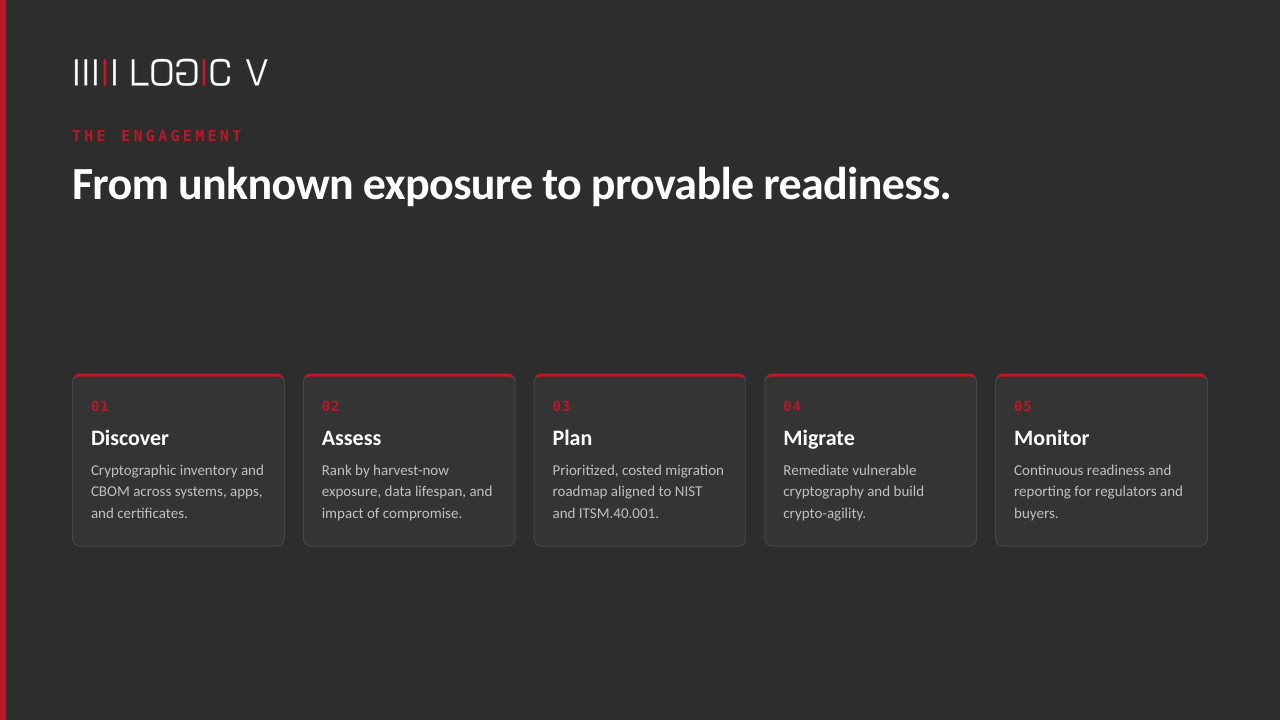
Quantum-Safe Readiness: Why Organisations Can’t Wait for Quantum Computing
The data you protect today is already being collected for tomorrow
“Harvest now, decrypt later” is no longer theoretical. Adversaries are already storing encrypted data with the expectation that future quantum computers will break today’s cryptographic standards.
For organisations handling long-lived sensitive data—financial records, intellectual property, identity data—the risk is not when quantum arrives, but whether your data still needs to remain secure when it does.

This fundamentally changes how risk must be assessed.
Why Quantum-Safe Readiness is becoming a business requirement
The shift to post-quantum cryptography is being driven not just by technology, but by regulation, procurement, and systemic risk.
Government procurement is enforcing it
Selling into government or regulated supply chains now increasingly requires quantum-safe readiness.
Critical infrastructure mandates are emerging
Regulations such as Canada’s CCSPA and US CNSA 2.0 are introducing mandatory cryptographic expectations across sectors like:
- Energy
- Finance
- Telecommunications
- Defence supply chains
Financial regulators are redefining “strong cryptography”
Supervisory bodies are converging toward post-quantum resilience as a baseline expectation—not optional future planning.
The timeline is already defined
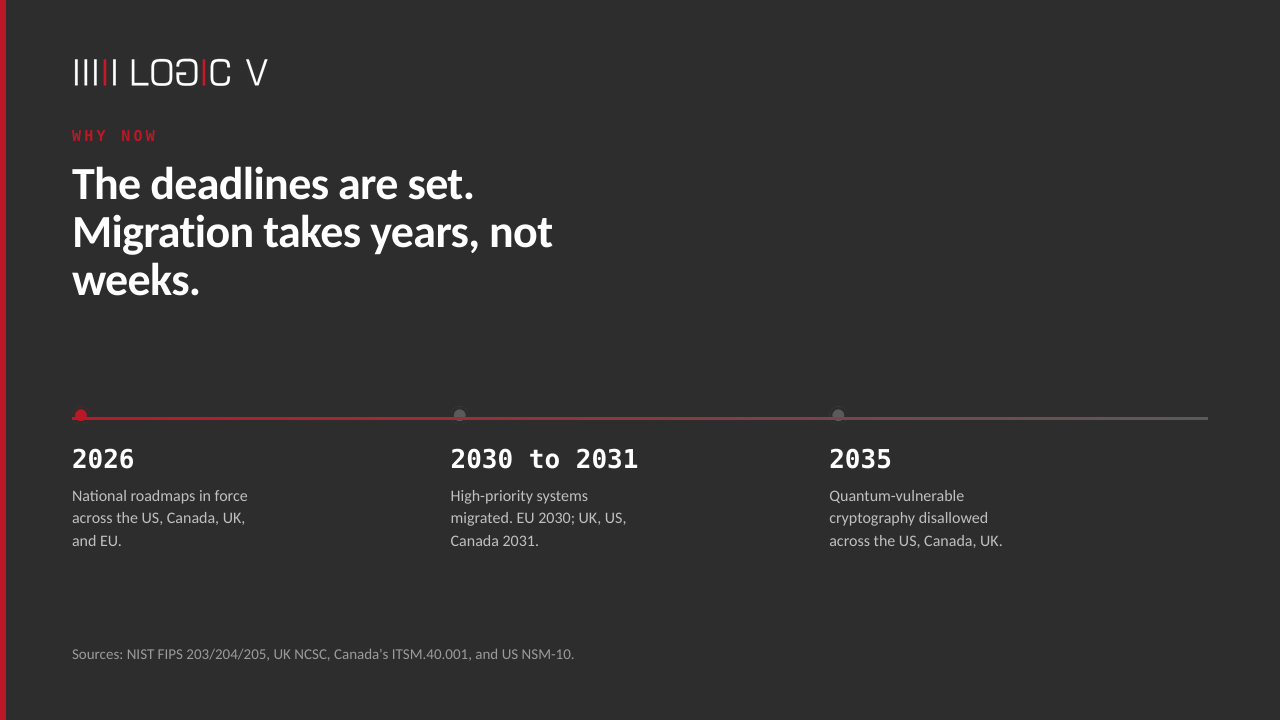
Organisations often assume quantum migration is distant. The reality:
- 2026 – National roadmaps enforced; procurement expectations begin
- 2030–2031 – High-priority systems must be migrated; RSA and ECC start being deprecated
- 2035 – Quantum-vulnerable cryptography is disallowed across major economies
This is not a technical refresh cycle. It is a multi-year transformation programme.
What “Quantum-Safe Readiness” actually means
Most organisations today do not know:
- Where cryptography exists in their environment
- Which systems rely on vulnerable algorithms
- Which data remains sensitive long enough to be exposed
Quantum-safe readiness is about moving from unknown exposure → provable control.
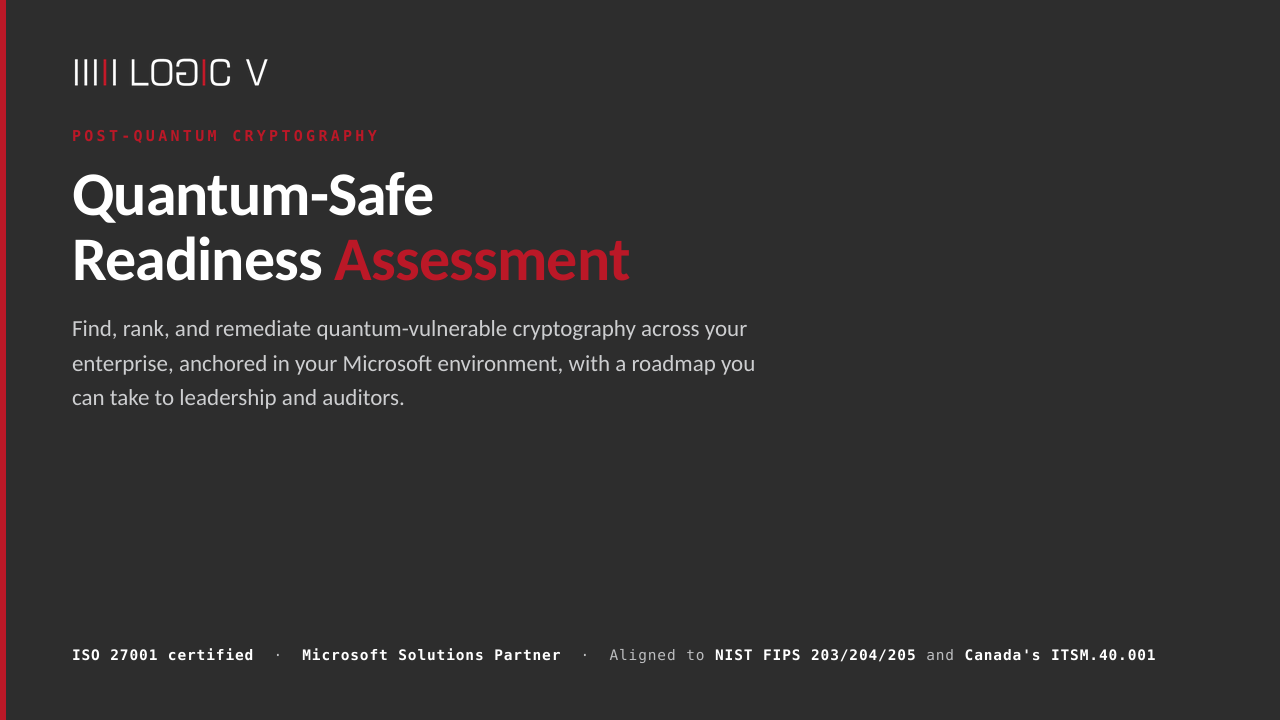
A practical approach to quantum-safe transformation
Discover — Build a Cryptographic Bill of Materials (CBOM)
Inventory cryptographic usage across:
- Applications
- Infrastructure
- Certificates
- Supply chain dependencies
Without this, migration is guesswork.
Assess — Prioritise based on real risk
Not all cryptography needs to be replaced at once.
Risk must be ranked based on:
- Harvest-now exposure
- Data lifespan
- Impact of compromise
This is where most organisations fail—they treat crypto rotation as an IT task, not a risk decision.
Plan — Build a defensible migration roadmap
A credible roadmap must be:
- Prioritised and costed
- Aligned to NIST FIPS 203/204/205
- Ready for auditors, regulators, and boards
This becomes a leadership decision, not just a security initiative.
Migrate — Replace and enable crypto-agility
Migration is not a one-time change.
Organisations must:
- Replace vulnerable algorithms
- Introduce hybrid or post-quantum cryptography
- Enable crypto-agility to adapt as standards evolve
Monitor — Prove continuous readiness
Ongoing governance is critical.
Organisations need:
- Continuous tracking of cryptographic posture
- Reporting aligned to regulatory expectations
- Evidence for procurement and audits
Who should act now
Quantum-safe readiness is not just for highly classified environments.
It directly impacts:
- Organisations with long-lived sensitive data
- Financial services and fintech
- Government and regulated supply chains
- Healthcare, utilities, and critical infrastructure
If your data needs to remain confidential beyond 5–10 years, the window to act has already opened.
From exposure to provable readiness
The biggest challenge is not migration—it is visibility.
Most organisations cannot answer:
- “Where are we using RSA or ECC today?”
- “Which systems are highest risk under quantum threat?”
- “How long do we have before exposure becomes material?”
Without these answers, there is no roadmap.
Why Logic V
Logic V approaches quantum readiness as a structured, defensible programme, not a product deployment:
- Cryptographic inventory and exposure mapping
- Risk-ranked findings aligned to real-world impact
- Migration roadmap aligned to NIST standards
- Continuous readiness reporting for regulators and partners
The outcome is simple:
From unknown exposure to provable readiness.