


Businesses today face immense pressure: they must do more with less while maintaining perfectly smooth operations. Traditional, outdated IT infrastructure often slows productivity, limits innovation, and significantly increases costs.
Cloud computing offers a definitive solution to these critical pain points, providing scalable, flexible, and inherently cost-efficient models.
The adoption rate proves its necessity: According to McKinsey, over 95% of organizations now use cloud services, yet about 30% of cloud spends are wasted. The message is clear: the benefits are undeniable, but utilization must be strategic.
“Companies that adopt cloud-first strategies experience faster deployment, higher security, and measurable operational improvements,” says CEO of Logic V.
The advantages of cloud computing are central to staying competitive, enabling you to streamline operations, scale resources, and secure data while fundamentally improving productivity across every team.
Faster Operations With Cloud Benefits
One of the most immediate and significant cloud computing benefits is the acceleration of operational speed and efficiency. Traditional IT infrastructure demands purchasing, configuring, and maintaining physical hardware and proprietary software licenses.
Each of these necessary steps introduces substantial delays, labor costs, and operational bottlenecks.
Cloud computing effectively eliminates these barriers, enabling rapid provisioning and deployment. You can initiate virtual servers, databases, or deploy complex Software as a Service (SaaS) applications in minutes without any need for physical hardware procurement or onsite configuration.
This shift delivers several crucial gains:
- Instant Scaling: Infrastructure instantly adapts to demand spikes. When your business experiences high traffic periods, such as a major product launch or seasonal rush, cloud resources scale automatically to prevent slowdowns.
- Real-Time Updates: Systems are always current. Cloud providers manage software patching, system maintenance, and essential security updates, ensuring your platforms consistently run the latest versions, drastically reducing downtime.
- Faster Project Launch: Reduces time-to-market. The ability to provision complex environments quickly means development teams can secure resources and launch new projects faster, drastically reducing IT bottlenecks that delay business initiatives.
Stop Wasting Time on Outdated IT Systems!
Move to cloud-based infrastructure that scales instantly and secures your data 24/7.
Flexibility and Scalability Drive Growth
The cloud advantages of flexibility and scalability fundamentally transform how businesses manage their IT infrastructure. Traditional on-premises systems are inherently rigid and expensive to adjust.
Cloud computing delivers dynamic options to meet fluctuating business demands without the need for overbuilding infrastructure. You can scale resources up or down instantly, significantly reducing unnecessary costs while consistently maintaining peak performance.
The modern cloud environment offers diverse operational models, allowing you to tailor solutions precisely to specific business needs:
- Public Cloud: Ideal for standard workloads. This model offers rapid, on-demand access to virtual machines and specialized software, enabling quick deployment and immense resource pooling.
- Private Cloud: Essential for sensitive data. This dedicated environment ensures full control and enhanced security, making it the preferred choice for regulated industries like finance, legal, or healthcare.
- Hybrid and Multicloud: Maximizes operational efficiency. These advanced strategies combine the best features of public and private clouds, allowing seamless workload portability and actively helping to mitigate vendor lock-in.
This flexibility ensures your IT infrastructure perfectly aligns with real-time business objectives. It also actively enables experimentation, rapid innovation, and faster scaling for launching new products or entering new markets.
Cost Savings From Cloud Computing Benefits
The financial advantages of adopting cloud computing are significant and clear. Transitioning to the cloud reliably reduces overall IT spending by eliminating expenses tied to hardware, software licenses, energy consumption, and facility maintenance.
Cloud providers structure their operations around a pay-as-you-go pricing model, ensuring you only pay for the specific resources you consume, which avoids costly upfront investments and resource underutilization.
Here is how cloud adoption translates into substantial financial benefits:
1. Capital Preservation
Cloud solutions largely eliminates large, upfront investments. Traditional IT requires purchasing servers, networking gear, and storage devices, assets that depreciate and demand continuous upgrades. Cloud services replace these with predictable operational subscription fees, freeing up capital for strategic business initiatives.
2. Reduced IT Spend
Cuts unnecessary expenditures. According to EA Journal, businesses can save up to 30% of their overall IT costs by optimizing cloud solutions.
3. Optimized Maintenance
Lowers risk and labor costs. Automatic system updates, centralized management, and provider-managed infrastructure significantly lower the risk of critical system failures and performance issues. This means your IT team spends less time on routine, reactive tasks and more time on strategic initiatives that drive core business value.
The cloud computing benefits in cost management reliably improve budgeting accuracy and empower the business to scale intelligently without experiencing financial strain.
|
Learn More About Cybersecurity: |
Benefits of Cloud Services for Enhanced Security and Reliability
Security and reliability stand as critical pillars for every modern business. Cloud benefits fundamentally enhance these areas by offering a suite of centralized and robust protective measures.
Cloud providers make massive, continuous investments in cybersecurity to shield sensitive information and guarantee high system uptime.
The integrated security architecture includes several key safeguards:
- Robust Defenses: Protects your vital assets. These services include advanced data encryption, mandatory multi-factor authentication, and sophisticated monitoring tools that identify and neutralize threats in real time.
- Business Continuity: Ensures always-on operations. Disaster recovery solutions automatically replicate your mission-critical data across multiple geographic facilities. If hardware failure occurs, your operations seamlessly shift, ensuring continuity without downtime.
- Compliance Support: Meets regulatory mandates easily. Cloud systems natively support complex adherence requirements like ISO 27001, ensuring your organization consistently meets all industry and government regulatory standards.
These essential benefits of cloud services significantly reduce operational risk, improve overall resilience, and give your entire organization confidence that data and applications are thoroughly protected.
Collaboration and Accessibility Advantages of Cloud Computing
By August 2023, 28% of employees embraced hybrid setups, and 13% were working fully remote.The rise of global teams, remote work, and hybrid office models demands truly seamless collaboration. Cloud advantages empower teams by allowing secure access to files and applications from any location, on any device. This capability ensures all employees, external partners, and clients have real-time visibility into the latest information.
Cloud architecture fundamentally simplifies modern teamwork:
- Real-Time Workflows: Eliminates version conflicts. Cloud storage and SaaS tools allow employees to work together on shared documents simultaneously, fostering efficient co-creation without the confusion of managing multiple file versions.
- Flexible Access: Supports business mobility. Mobile access guarantees business continuity and productivity, even when employees are outside traditional office environments. Teams can quickly respond to customer inquiries and coordinate complex projects across different time zones.
- Accelerated Decisions: Speeds up insights. The universal accessibility to real-time data allows teams to share insights and make informed, data-driven decisions much faster, eliminating delays caused by information silos.
These crucial cloud computing benefits increase productivity and dramatically reduce operational friction.
Driving Strategic Value With Cloud Benefits
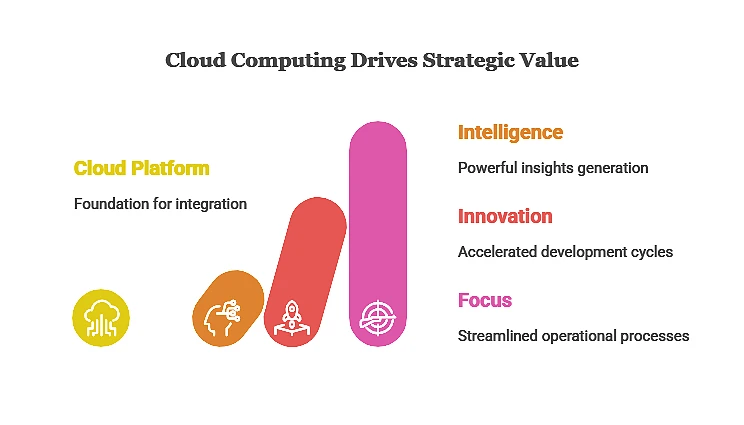
Beyond optimizing efficiency and delivering substantial cost savings, the benefits of cloud computing fundamentally drive strategic business value. Cloud platforms serve as the essential foundation for integrating advanced technologies, generating powerful insights, and establishing a sustained competitive edge.
The cloud provides specific strategic accelerators:
- Intelligence and Insights: Cloud environments enable seamless integration with powerful tools like Artificial Intelligence (AI), advanced analytics, and Machine Learning (ML). This provides your leadership teams with real-time, deep insights to reliably guide strategic business decisions.
- Innovation Velocity: Organizations operating with cloud-first strategies can rapidly deploy emerging technologies and new tools, allowing the business to quickly respond to market shifts and innovate without the constraints of outdated physical infrastructure.
- Operational Focus: Cloud automation significantly reduces the burden of manual, routine IT tasks, freeing up your internal teams to focus their expertise on high-value initiatives that directly contribute to growth and product development.
Investing in cloud solutions actively positions your business for long-term sustainable growth, improves agility in decision-making, and builds resilience against evolving technology demands.
Considerations When Adopting Cloud Services
To maximize the benefits of cloud computing, a strategic, structured approach to adoption is essential. It is vital to assess your current workloads, understand your specific security requirements, and carefully evaluate vendor capabilities before making the transition.
Key areas require focused preparation:
- Workload Assessment: Analyze your existing applications and data to determine which are optimally suited for a public, private, or hybrid cloud environment, so resources are optimized for performance and security.
- Shared Security Model: Recognize that security is a joint responsibility. The provider secures the infrastructure and platform, while your organization must secure the applications, data integrity, and user access. Implement zero-trust policies and MFA.
- Cost Optimization: Tracking usage across various providers is critical to avoid overspending. Review Service Level Agreements) rigorously to ensure requirements for uptime guarantees, latency, and data availability align with your business needs.
Cloud Benefits Comparison Table
Before wrapping up, it is highly useful to visualize precisely how cloud computing delivers advantages across different operational areas.
The following table highlights the key benefits alongside the direct business outcomes to help you plan your strategic cloud adoption.
| Cloud Benefit | Description | Business Outcome |
| Faster Operations | Rapid provisioning, real-time updates, instant scaling | Reduced project timelines, increased agility |
| Flexibility & Scalability | Adjust resources up or down, hybrid and multicloud options | Optimized infrastructure, minimal overprovisioning |
| Cost Savings | Pay-as-you-go model, reduced hardware and maintenance | Lower overall IT spending, predictable budgeting |
| Security & Reliability | Centralized backups, encryption, disaster recovery | Improved data protection, regulatory compliance |
| Collaboration & Accessibility | Global access to SaaS tools, mobile access support | Higher productivity, effective remote work enablement |
| Strategic Value | Integration of AI, advanced analytics, sustainability features | Competitive advantage, smarter decision-making |
Leverage Logic V for Cloud Computing Benefits
The powerful benefits of cloud computing fundamentally transform businesses by consistently delivering efficiency, flexibility, significant cost savings, enhanced security, and crucial strategic growth opportunities. Making the transition requires a trusted partner to ensure maximum return.
Logic V is a leading provider of innovative cloud solutions, helping over 34 companies efficiently support 200,000+ end users across diverse platforms. With an impressive 80% first-call resolution rate, Logic V ensures that your critical IT operations remain reliable and completely seamless.
We empower your business to capture every cloud advantage:
- Accelerated Growth
- Optimized Resources
- Improved Productivity
Contact us today to explore how these proven cloud benefits can transform your enterprise. Start building smarter, scalable, and inherently secure IT infrastructure that is ready for the future.