


Amazon Web Services (AWS), Microsoft Azure, and Google Cloud Platform (GCP) are the three biggest names in cloud computing. They offer services that help businesses build websites, store data, run applications, and much more, without buying a room full of servers. But what’s the difference between AWS vs Azure vs Google Cloud? And which one is right for you?
That really depends on what your business needs, what tools you already use, and how comfortable you are with managing cloud technology. For example, some companies choose AWS for its long-standing reputation and broad set of services.
Others go with Azure because they already use Microsoft tools like Office or Teams. Google Cloud? It’s often the pick for data-heavy companies working with AI or analytics.
Whether you’re a small business exploring your first cloud move, a developer comparing services, or a decision-maker weighing your options, understanding the differences between these cloud giants is a good place to start.
In this blog, we’ll break down what each platform offers, how they compare, and what to consider when choosing one over the others. Here’s what you’ll learn:
- AWS vs Azure vs GCP: Quick Comparison
- What is AWS, Azure, and Google Cloud?
- AWS vs Azure vs Google Cloud Services Comparison
- Pricing Comparison of AWS, Azure and Google Cloud
- Big 3 Cloud Platform Comparison: Which is Best for You?
Quick Cloud Platforms Comparison: AWS vs Azure vs Google Cloud
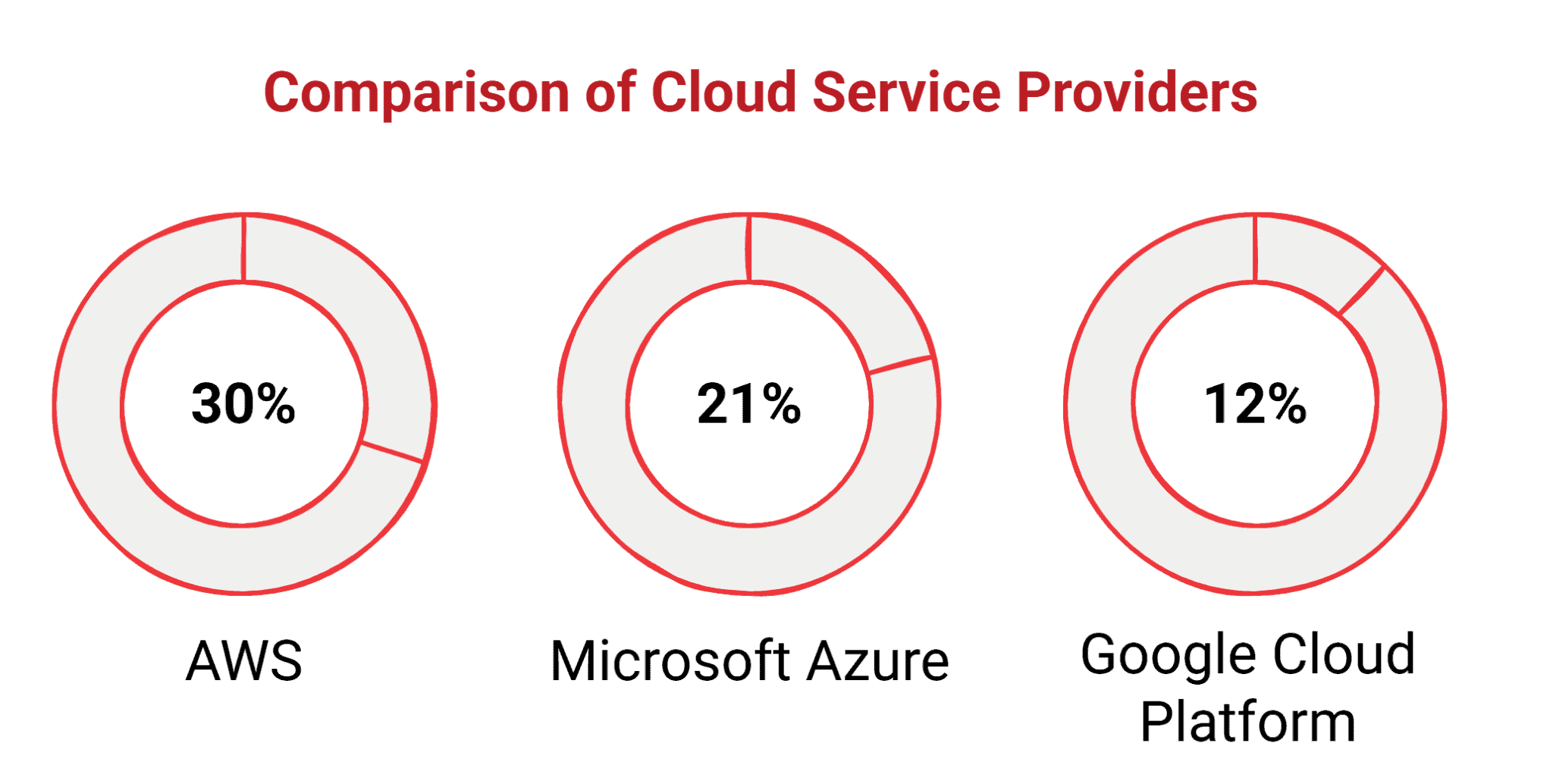
Before diving deeper into services and features, it helps to get a bird’s-eye view of how these cloud platforms stack up historically and globally. The table below outlines when each launched, how much of the market they currently hold, and how far their infrastructure reaches.
| Feature | AWS | Microsoft Azure | Google Cloud Platform (GCP) |
| Launch Year | 2006 | 2010 | 2008 |
| Estimated Market Share | ~30% | ~21% | ~12% |
| Global Regions | 33 | 60+ | 40+ |
| Availability Zones | 114+ | 120+ | 130+ |
| Data Center Footprint | Widest, especially in the U.S. | Strong in enterprise regions | High-performance network |
- AWS was the first major cloud platform and remains the largest by market share, known for its wide range of services and deep global infrastructure.
- Azure has grown quickly due to Microsoft’s dominance in the enterprise world, with regional availability closely aligned to business centers around the world.
- Google Cloud may be smaller in market share but is known for high-speed networking and innovation in AI, data, and containerization.
What are AWS, Azure, and Google Cloud?
Each of the big three cloud providers brings something different to the table. While they all offer the same foundational services, like storage, virtual machines, and databases, they were built for different strengths and user priorities. Here’s a quick look at AWS vs GCP vs Azure:
Amazon Web Services
AWS was the first major player in the cloud space, launching back in 2006. It’s known for being the most mature and feature-rich cloud platform available today. From startups to massive enterprises (and even Netflix), AWS supports all kinds of organizations with services that span everything from virtual servers to machine learning.
Why people choose AWS:
- Industry leader with the largest market share
- Huge catalog of services, over 200 and counting
- Flexible pricing options for nearly every workload
- Strong ecosystem for startups, DevOps, and global scalability
But because it offers so much, AWS can also be overwhelming to navigate, especially for new users.
Google Cloud Platform
GCP launched in 2008 and is Google’s answer to cloud infrastructure. While it has a smaller slice of the market, it shines in areas like data analytics, machine learning, and open-source innovation.
Google’s global network is one of the fastest and most robust in the world, and tools like BigQuery and Vertex AI make it especially attractive to data-driven teams.
Why people choose Google Cloud:
- World-class tools for AI, ML, and big data
- Built-in Kubernetes leadership (Google created it)
- Developer-friendly platform with strong open-source roots
- High-speed network performance and low-latency access
GCP is often chosen by tech-forward teams or companies with a strong focus on innovation, though it may lack some of the enterprise integrations found in AWS or Azure.
Why Move To The Cloud? 5 Facts To Know.
|
Microsoft Azure
Azure came onto the scene in 2010, backed by Microsoft’s enterprise footprint. It’s especially popular among companies already using Microsoft tools like Office 365, SharePoint, or Dynamics. If you’re a business that relies on Windows, Active Directory, or SQL Server, Azure is usually a natural fit.
Why people choose Azure:
- Seamless integration with Microsoft products
- Ideal for hybrid cloud and on-prem setups
- Deep enterprise support and security features
- Strong presence in industries like finance, healthcare, and government
Azure’s offerings are deep and growing fast, though its interface and documentation can sometimes feel inconsistent depending on the product.
AWS vs Azure vs Google Cloud Services Comparison
All three platforms offer the same general building blocks that include compute power, storage, networking, and more. However, each does it in slightly different ways. If you’ve ever spun up a virtual machine or stored files in the cloud, you’ve used one of these core services.
Here’s how the big three compare:
| AWS | Azure | Google Cloud | |
| Compute (VMs) | Amazon EC2 | Azure Virtual Machines | Compute Engine |
| Serverless | AWS Lambda | Azure Functions | Cloud Functions |
| Containers | Amazon ECS / EKS | Azure Kubernetes Service (AKS) | Google Kubernetes Engine (GKE) |
| Storage | Amazon S3 | Azure Blob Storage | Google Cloud Storage |
| Databases | RDS, DynamoDB, Redshift | Azure SQL, Cosmos DB | Cloud SQL, Firestore, Bigtable |
| Networking | VPC, Route 53, Direct Connect | Virtual Network, ExpressRoute | VPC, Cloud CDN, Interconnect |
| AI & Machine Learning | SageMaker, Comprehend, Rekognition | Azure AI, Cognitive Services | Vertex AI, AutoML, Dialogflow |
A few key notes:
- Compute: All three offer flexible virtual machine options, but AWS tends to offer the broadest instance types and most fine-tuned controls.
- Serverless: AWS Lambda was the first and remains a leader. GCP’s Cloud Functions are very developer-friendly.
- Containers: Google Cloud leads here. After all, Kubernetes was born at Google. GKE is often seen as the gold standard for container orchestration.
- Storage: S3 is practically synonymous with object storage. Azure Blob and Google Cloud Storage are close competitors with strong capabilities.
- Databases: All platforms support SQL and NoSQL offerings, along with fully managed options. Google is popular for real-time databases, while AWS dominates with variety.
- AI/ML: GCP is the clear standout for AI/ML, with tools like Vertex AI and native TensorFlow support. Azure offers solid AI integrations for business use cases. AWS has breadth but can be more complex to use out of the box.
Pricing Comparison of AWS, Azure and Google Cloud
When it comes to pricing, all three providers follow a pay-as-you-go model. This means you’re charged only for what you use. However, this isn’t as straightforward as one might think. It’s not uncommon for a cloud bill to have hundreds of millions, or even billions of rows, of data. Moreover, nearly 50% of businesses struggle to keep cloud costs under control.
Here’s a simplified look at how pricing works on each platform:
| AWS | Azure | Google Cloud | |
| Pricing Model | Pay-as-you-go, Reserved Instances, Savings Plans | Pay-as-you-go, Reserved Instances, Spot VMs | Pay-as-you-go, Committed Use, Sustained Use Discounts |
| Free Tier | 12-month and always-free services | 12-month and always-free services | Always-free tier + $300 free credits (90 days) |
| Discount Options | Requires pre-commitment (Savings Plans, RIs) | Reserved pricing with longer commitments | Discounts apply automatically with use |
| Spot/Pricing Flexibility | EC2 Spot Instances for big savings | Spot VMs available | Preemptible VMs (low-cost, short duration) |
| Billing Granularity | Per-second for many services | Per-second for most compute | Per-second billing for all major services |
| Pricing Transparency | Deep but complex service catalog | Easier UI, integrated into Azure Portal | User-friendly calculator and clear pricing |
What to watch for
- AWS gives you the most ways to save, but most require upfront commitments. Tools like Savings Plans or Reserved Instances can lower costs if you know your usage in advance.
- Azure has competitive pricing, especially for organizations already using Microsoft products. Discounts are available, but require some planning.
- Google Cloud is often praised for its simplicity and automatic discounts. If you run consistent workloads, GCP may lower your costs without needing long-term contracts.
| 💡 Tip: Cloud pricing calculators can help estimate real-world costs. Here are official tools you can try: |
Big 3 Cloud Platform Comparison: Which is Best for You?
Each cloud provider has its strengths. The right one for you depends on what you’re building, how much control you need, and what tools you already use.
Here’s a quick guide based on common scenarios:
✅ Choose AWS if…
- You need the widest range of services and global coverage
- You’re building something complex and need fine-grained control
- You’re a startup or tech company that values developer flexibility
- You want to scale across regions with enterprise-grade infrastructure
Best for: High-growth startups, global apps, DevOps-heavy teams
✅ Choose Azure if…
- You already rely on Microsoft tools like Office 365, Active Directory, or Windows Server
- You’re in a regulated industry and need strong governance tools
- You’re planning a hybrid cloud setup (mix of on-premises + cloud)
- You want smooth integration with Microsoft licensing and enterprise IT
Best for: Large enterprises, government, financial services, healthcare
✅ Choose Google Cloud if…
- You’re building apps that rely on data, analytics, or AI
- You prefer open-source and modern development tools
- You’re using containers and want the best Kubernetes experience
- You want predictable performance with one of the fastest global networks
Best for: Data scientists, SaaS companies, AI/ML teams, developers
If you’re not sure which direction to take, consult with cloud implementation and management experts, such as the team at Logic V. We’ll help you identify your top priorities and help create a roadmap best for you. All three platforms are powerful, but one may fit your organization’s style, stack, or goals better than the others.
Read these next: |
Ready to Choose Your Cloud? Don’t Go It Alone.
Whether you’re comparing services or planning a migration, the cloud isn’t one-size-fits-all. The best way to get lasting value, without costly detours or long-term disruptions, is to work with a cloud expert who understands your goals, workloads, and industry needs.
At Logic V, we help businesses navigate AWS, Azure, and Google Cloud with clarity and confidence. From platform selection to architecture and ongoing support, we guide you toward a setup that works today and scales for tomorrow.
Let’s build your cloud strategy the right way. Let’s do it together.