


Azure continues to evolve—not just as Microsoft’s cloud platform, but as a foundation for how modern enterprises operate, secure, and scale their digital environments. If your organization is evaluating a shift to the cloud, understanding the full scope of Azure cloud migration benefits is more exciting than ever.
“Azure isn’t just the cloud of choice for Microsoft-first organizations—it’s becoming the enterprise standard for how to do cloud right,” says Hemang Shah, CEO of Logic V. “With the improvements we’ve seen across identity, governance, and operational control, now is one of the most strategic times to move.”
Whether you’re in a hybrid environment, managing legacy systems, or starting your cloud journey, this blog will help you evaluate Azure from both a technical and strategic lens.
First, Why Migrate to the Cloud?
96% of companies now use a public cloud. Cloud migration has shifted from being a forward-looking IT trend to a critical business strategy. If you’re asking, “Should I migrate to the cloud?”, it’s important to know that cloud adoption isn’t just for large enterprises and global organizations, it’s for everyone.
In fact, it’s projected that 63% of SMB workloads and 62% of SMB data will be hosted in the cloud within the next year.
In Canada, where 97.8% of employers are small business owners, this shift is transforming how entire industries operate. From accountants and construction firms to healthcare clinics and startups, more SMBs are reaping the benefits of migrating to the cloud.
Here are some of the most common reasons why moving to the cloud makes sense:
- Accelerate innovation and time to market. Quickly launch new products, deploy services, or respond to changing business needs without waiting on infrastructure.
- Improve business resilience. Cloud platforms offer built-in redundancy, automated backups, and disaster recovery to reduce downtime and keep operations running.
- Strengthen security without adding headcount. Cloud providers offer built-in tools for threat detection, access control, and continuous monitoring, helping you protect data without expanding your internal security team.
- Support flexible and remote workforces. Employees can securely access systems, files, and applications from anywhere, improving collaboration and business continuity.
- Scale as your business grows. Cloud environments adapt to real-time demand, so you can scale up or down without overcommitting to infrastructure you may not need long term.
- Gain access to advanced technology. Cloud platforms provide easier entry points to tools like artificial intelligence, automation, and analytics that help teams make better decisions and improve efficiency.
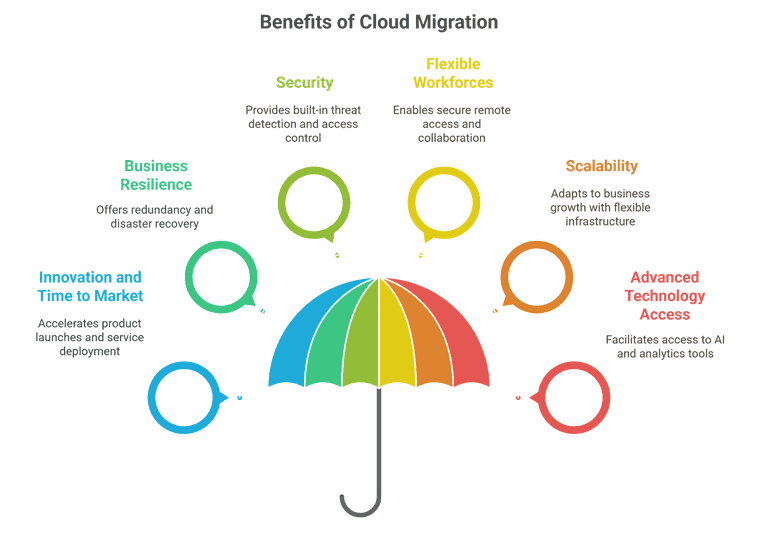
Ultimately, the benefits of moving to the cloud go beyond IT operations—they directly impact competitiveness, customer experience, and long-term strategic growth.
Which brings us to the next question: why choose Azure?
Why Organizations Have Chosen Microsoft Azure For 10+ Years
Microsoft Azure has long been a top cloud choice for good reason. Its flexibility, security, and integration with widely used enterprise tools make it a strong fit for businesses navigating digital transformation. But beyond the technical strengths, Azure offers real business advantages that support growth, reduce risk, and improve efficiency.
Here are 4 Azure cloud benefits that make it the platform of choice for organizations, and businesses of all sizes, moving to the cloud:
1. Deep integration with Microsoft ecosystems
Azure works naturally with technologies many organizations already use, including Microsoft 365, Windows Server, SQL Server, Dynamics, and SharePoint. It offers native identity management through Azure Active Directory and Entra ID, and hybrid-use licensing simplifies migration and long-term management.
Why this matters:
A cloud migration can move faster and with fewer disruptions when your tools already work together. If your team already uses Microsoft tools, Azure simplifies the transition by reducing setup time and compatibility issues, allowing you to stay focused on strategic priorities rather than technical hurdles.
2. Enterprise-grade security and compliance
Azure includes a full set of built-in security features, such as:
- Network security groups (NSGs) for network-level protection
- Application firewalls to filter malicious traffic
- Privileged identity management to limit and track access
- Microsoft Sentinel for real-time, AI-driven threat detection
It also meets over 100 compliance certifications, including HIPAA, ISO 27001, FedRAMP, and GDPR.
Why this matters:
Azure delivers strong protection and regulatory alignment without the need to build a large internal security team. Azure helps reduce risk, streamline audits, and maintain customer trust.
3. Global reach with local performance
Azure has more than 60 regions across 140 countries, enabling businesses to host applications near their users while meeting local data requirements. Services like Azure Front Door, Traffic Manager, and Availability Zones ensure fast, reliable access no matter where users are located.
Why this matters:
Easily access and serve global customers or distributed teams without sacrificing speed, availability, or compliance. This creates better user experiences and supports international growth.
4. Hybrid and multicloud flexibility
Azure supports both full cloud and hybrid deployments. With tools like Azure Arc and Azure Stack, you can connect cloud and on-premises environments, apply consistent governance, and integrate with existing infrastructure.
Why this matters:
This flexibility allows businesses to modernize at their own pace while maintaining existing systems and ensuring consistent operations across cloud, on-premises, and multicloud environments.
Start Your Azure Migration the Right Way
Schedule a free assessment to map out your cloud priorities, uncover risks, and create a clear path forward with expert guidance.
What Azure Cloud Benefits Make It Even More Compelling Today
Azure has always been a strong choice for organizations invested in the Microsoft ecosystem. But in recent years, the platform has expanded in ways that make the benefits of a cloud migration even more valuable, from both a technical and business perspective.
Azure Policy, Blueprints, And Microsoft Purview: Scalable Governance Without Overhead
What it does:
These tools enforce security, compliance, and resource standards automatically across Azure environments. Organizations can apply templates, restrict risky configurations, and monitor compliance in real time.
Where this delivers value:
Teams reduce manual oversight and avoid configuration drift while keeping environments aligned with internal policies and industry regulations.
Real-world application:
A regional healthcare provider uses Azure Policy to enforce data encryption and region-specific compliance rules across development and production environments, without relying on manual checklists or separate tools.
Azure Monitor, Advisor, and Cost Management: Clearer Insight Into Performance And Resource Use
What it does:
These tools provide visibility into system performance, infrastructure utilization, and cloud spending. Azure Advisor offers optimization suggestions based on real-time usage patterns.
Where this delivers value:
Organizations can right-size resources, improve service reliability, and make proactive decisions about scaling and budgeting.
Real-world application:
A SaaS company uses Azure Monitor to track performance bottlenecks across services, then applies Azure Advisor recommendations to reduce compute waste, resulting in faster load times and improved user satisfaction.
Read these next: |
Azure Arc: Hybrid And Multicloud Support Without Added Complexity
What it does:
Azure Arc enables centralized management for resources across Azure, on-premises infrastructure, and other cloud providers. Teams can apply governance and security policies consistently from a single interface.
Where this delivers value:
IT leaders maintain control of legacy systems while modernizing incrementally. This reduces migration risk and allows for flexible adoption timelines.
Real-world application:
A manufacturing company with strict data residency requirements uses Azure Arc to extend Azure security policies to its on-prem ERP system while starting a phased migration of less sensitive workloads.
Azure OpenAI Service, Logic Apps, and Machine Learning Studio: Practical AI and automation
What it does:
These services let teams build predictive models, automate processes, and integrate AI into applications—often with low-code or no-code tools.
Where this delivers value:
Organizations improve efficiency, reduce manual work, and deliver smarter customer and employee experiences.
Real-world application:
An insurance firm uses Azure OpenAI Service to summarize claims data and Logic Apps to route flagged claims to internal teams, cutting processing time by 40%.
Azure Deployment Environments (Adf) And Arm Templates: Faster, More Consistent Deployment
What it does:
ADF and ARM allow teams to launch preconfigured, compliant environments and infrastructure from templates. Updates have reduced deployment errors and validation time significantly.
Where this delivers value:
Development and operations teams can spin up environments quickly, avoid inconsistencies, and standardize application rollouts.
Real-world application:
A financial services firm uses ARM templates to ensure all new dev environments meet internal security standards, reducing configuration time by over 60% and supporting faster release cycles.
Why Migrate to Azure Now?The decision to migrate to the cloud is rarely about checking a box. It’s about enabling the business to move faster, stay secure, and adapt to what’s next. Azure’s recent enhancements in governance, AI, hybrid flexibility, and deployment efficiency make it not just a strong option, but a strategic one. Delaying migration often means working around aging infrastructure, struggling to integrate modern tools, or relying on manual processes that competitors have already automated. For many organizations, the question is no longer if Azure is the right platform. It’s how soon to begin. Benefits of a cloud migration today:
|
How Logic V Supports Your Azure Migration
Migrating to Azure is more than just moving data from one place to another. It’s about making smart decisions that set your business up for long-term success. From understanding what to move and when, to making sure everything runs smoothly after the migration, Logic V helps guide the entire process with clarity and experience.
Here’s how we support your Azure migration:
- We start with a cloud assessment to map your current systems to the right Azure services
- We build a clear migration plan that breaks the process into manageable steps
- We use trusted Microsoft tools to make the move safe, smooth, and efficient
- We help fine-tune your environment after the migration to improve performance and visibility
- We stick around for long-term support, helping you get the most from Azure as your needs evolve
Contact us today. Let’s make your move to the cloud as easy as possible.